 On
 (1,243 reviews) – Ask About Our Financing Options

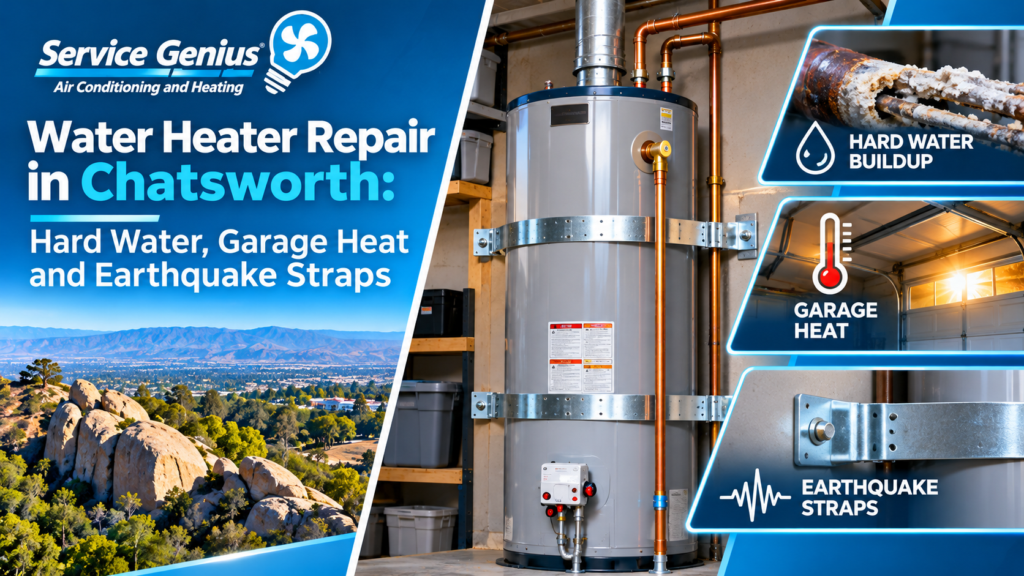
With frequent earthquakes, intense heat, and hard water scale in Chatsworth, your water heater faces many stressors that affect performance and reliability. At Service Genius, we provide water heater repair in Chatsworth, California, helping households resolve breakdowns and keep their hot water flowing safely.
How Chatsworth Conditions Affect Your Water Heater
Chatsworth’s environmental conditions can challenge your water heater. San Fernando Valley water heater repairs may be related to these local conditions:
- Scale from high calcium and magnesium levels in Southern California’s water supply coats heating components and reduces performance.
- Chatsworth is in Southern California’s active seismic zone, and earthquakes can tip unsecured water heaters, creating major hazards.
- Intense summer heat can raise the ambient temperature around the unit, especially in unconditioned garages, and may stress electrical components and metal.
Signs Your Water Heater Needs Repair
Contact Service Genius if you notice these signs that your water heater needs repair:
- Inconsistent, lukewarm, or cold temperatures from faucets
- Rumbling, popping, banging, or other new or loud sounds
- Discolored or cloudy water
- Unpleasant sulfur-like odors
- High energy bills
- Leaks near the tank or fittings
How Hard Water Creates Sediment and Scale Buildup
Mineral content ranges from 96 to 280 mg/L (moderately hard to very hard) in the drinking water supplied by the Los Angeles Department of Water and Power (LADWP), leading to hard water heater problems in Chatsworth. These dissolved minerals harden into crystals when heated, resulting in layers of sediment and limescale crusts on hot surfaces, such as water heater tanks or electric elements.
Why Your Water Heater Is Making Popping or Rumbling Noises
Popping or rumbling noises from your water heater usually point to sediment accumulated at the bottom of the tank. Hardened sediment traps water and heat beneath it, causing the water to boil against the tank liner and the water heater to make noises like growling or rumbling sounds. Popping or crackling sounds usually come from steam escaping through the sediment.
Why Your Water Heater May Stop Producing Enough Hot Water
Different factors may cause your water heater to not heat up quickly or reliably:
- Water heater sediment buildup blocking heat transfer.
- Failing burners or heating elements.
- Faulty or improperly set thermostats.
- An undersized tank or limited tankless flow rate.
- Cracked dip tube.
- Pilot light or ignition failures.
- Stuck or worn-out mixing valves.
Common Water Heater Leaks and What They Can Mean
These are the most common sources of water heater leaks and what they may mean for your system:
- Temperature and pressure relief valve leak: Water dripping from the water heater pressure relief valve discharge means that the tank pressure is too high. If the pressure is normal, the T&P valve may be worn out or clogged with sediment.
- Leaking drain valves or connections: Loose or corroded drain valves at the bottom of the tank can cause puddles to form around the base. Some connections may need replacement due to wear, while others may only need tightening or a gasket replacement.
- Internal tank corrosion: Water leaking from the bottom or seams of the tank, or pooling around the unit, may indicate that the tank lining has corroded and deteriorated, requiring replacement of the entire water heater.
- Condensation: Water may not always mean a leak — condensation can form on the unit’s surfaces due to large amounts of cold incoming water or high ambient heat and humidity.
Pilot Light, Thermocouple, and Ignition Problems
Gas water heaters rely on a precise ignition sequence, and even minor problems can noticeably impact performance. Service Genius provides water heater pilot light repair and water heater thermocouple repair in Chatsworth, addressing problems such as:
- Pilot light won’t stay lit: If the pilot light goes out immediately, the thermocouple may fail to detect the flame and cut off the gas supply.
- Pilot won’t light at all: A clogged pilot orifice or closed gas valve prevents the pilot light from receiving enough fuel to start.
- Weak or yellow pilot flame: Pilot lights should be blue and steady. Weak, flickering, or yellow/orange flames indicate incomplete combustion.
- Thermocouple failure: Bent, dirty, or degraded thermocouples may prevent heating or trigger safety shut-offs.
How Garage Heat and Dust Affect Water Heater Conditions
Because basements are uncommon, water heater garage installations in Chatsworth and Southern California homes are typical. Service Genius provides garage water heater repair in Chatsworth, whether for dust or heat.
Hot garage temperatures can help heat pump water heaters, but only up to a point. In summer, temperatures in closed, unconditioned garages can exceed outdoor temperatures by 20°F to 35°F, sometimes reaching 110°F to 135°F. Intense ambient heat stresses sensitive electronic components, and thermal expansion can strain connections and valves.
Most garages also have a consistent layer of dust. Dirt and debris can clog gas burners and air intakes, interfering with ignition and causing inefficient, incomplete combustion.
What to Check Around a Garage Water Heater
Find problems early and keep your garage water heater running safely with these checks:
- Store paint, fuel, and other flammable materials away from the unit.
- Periodically inspect the water heater for leaks or corrosion.
- Check the heater against code requirements — burners and ignition components should be elevated by at least 18 inches, and the unit must be protected from potential vehicle impacts.
- After an earthquake, check the water heater for gas leaks and that the tank is still secured with straps.
Why Earthquake Straps Matter in Chatsworth
Under the California Plumbing Code, water heater earthquake straps in Chatsworth are an essential and required safety measure. Homes located in the seismically active San Fernando Valley face a higher risk of moderate to severe earthquakes that can dislodge heavy, unbraced water heaters and cause gas leaks, flooding, and fires. Earthquake straps anchor water heaters to the wall studs to keep them from tipping over or shifting during seismic events.
How Water Heater Seismic Straps Should Be Positioned
For tanks up to 52 gallons, install two water heater seismic straps at the upper and lower thirds of the unit’s height. Tanks over 53 gallons may require three straps, with the additional strap around the middle of the unit. The straps must connect to a secure structural support, such as wall studs or concrete, wrap around the tank, and then connect again to the structural support. The water heater should be within two inches of the wall or structural support.
Tank Water Heater Problems vs. Tankless Water Heater Problems
Tank water heaters and tankless water heaters have problems specific to their different designs and how they work.
Traditional tank water heater problems include:
- Ruptured or leaking water heater
- Rusty water from depleted anode rods
- Sediment buildup inside the tank
- Standby energy waste
- Slow recovery or limited tank capacity
Tankless water heaters don’t deal with standby energy loss or tank leaks, but they may pose other problems without regular water heater services or prompt repairs:
- Limescale deposits on heating elements
- Flow rate limitations
- Cold water sandwiches
When Flushing or Descaling May Improve Performance
Water heater flushing or descaling improves performance in both tank and tankless units. Sediment in tanks and scaling on tankless heat exchangers reduce efficiency, cause inconsistent or lukewarm temperatures, and slow tank recovery times. Regular flushing or descaling removes this buildup to minimize strain, offering benefits such as:
- Reliable hot water
- Improved energy efficiency
- Reduced wear and breakdown risk
- Extended operating life
- Warranty protection
How Service Genius Diagnoses Chatsworth Water Heater Problems
At Service Genius, our team of licensed and certified technicians thoroughly inspect your water heater to identify the underlying cause of symptoms and accurately diagnose your equipment. We check the anode rod’s condition to stop internal rusting, tighten and repair leaking connections or valves, and verify proper exhaust venting. Our knowledge and experience also allow us to employ specialized tools and measurements to assess performance and identify underperforming or failing components.
Once we pinpoint the problem, we recommend electric or gas water heater repair in Chatsworth with clear estimates and a focus on customer satisfaction. If the system is beyond tank or tankless water heater repairs, we also consider when replacement may be a more practical option for your household’s safety, energy efficiency, and comfort.
Get Your Chatsworth Water Heater Working Reliably With Service Genius
Choose Service Genius for heating, cooling, water heater, and indoor air quality service across Los Angeles, from Chatsworth to Santa Monica. Contact Service Genius today!