 On
On  (1,243 reviews) – Ask About Our Financing Options

Repair or Replace Calculator
Disclaimer: Please use this as a starting point and always check with a licensed HVAC professional for advice about your system.
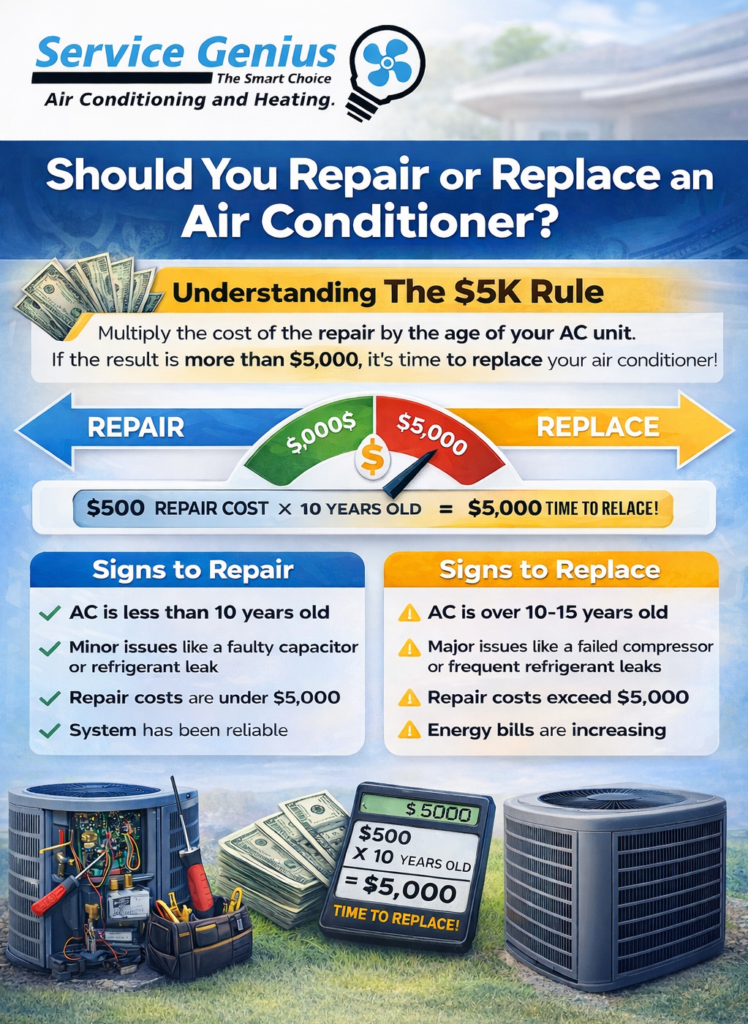
The $5,000 rule is an industry-accepted rule for determining whether to repair or replace an HVAC system. If the cost exceeds $5,000 and is not covered by warranty, you should replace it. Consult a licensed HVAC professional to help make the best decisions about your equipment.
Contact UsAir conditioners typically last 10–15 years, but lifespan depends heavily on maintenance, climate, and usage—especially in hot markets like Los Angeles.
Every day, homeowners throughout Los Angeles weigh the decision of whether to repair or replace an air conditioner. A repair is usually an option worth considering. It’s less expensive than buying a new AC system. But is it worth it in the long run?
From understanding the $5K rule to knowing how long an air conditioner can last to recognizing key signs you should replace it, we’ll look at the primary factors to help you make a decision.
Understanding the Repair vs. Replace Decision
Are you unsure whether to repair or replace your AC system? You’re not alone. When an air conditioner breaks down or isn’t providing efficient cooling, homeowners may think the worst or go with the most affordable option. It often takes just a simple repair to get an AC running again, but what will it ultimately cost you? Could an AC efficiency upgrade ultimately save you money over time?
What Is the 5K Rule for Air Conditioners?
In the AC industry, we take the 5K rule seriously. The math is quite simple (even if $5,000 seems like a big number). It’s significant because it helps you understand AC repair vs. replacement from a short-term and long-term cost perspective. It also accounts for the fact that the older an air conditioner is, the less efficient it becomes, the more likely it is to break down, and the more frequent and costly repairs can be.
How to Calculate the $5K Rule for Your System
If you know the AC unit’s age, multiply that number by the cost of a repair. To apply this guideline, consider the following:
- If the total is greater than $5,000, replacing the unit is the best decision.
- If the total is less than $5,000, repairing it is a cost-effective choice.
The number of recent repairs is also something to consider. How many times has your air conditioner been fixed in the past year? Requiring multiple repairs from an AC company in a short time greatly increases the system’s lifetime cost.
Average Lifespan of an Air Conditioning System
Air conditioners last about 10 to 15 years on average. Knowing your AC’s age helps determine if you should replace it. However, the lifespan of any one system depends on factors such as how well it’s maintained (regular AC Tune-ups increase life expectancy) and climate (ACs in hotter climates work harder and can break down sooner). The quality of the brand, model, and parts and materials is also a factor.
Key Signs Your AC Needs Replacement
An air conditioner that’s 15+ years old is near the end of its lifespan, so planning for an AC replacement is a good idea. But aside from age and frequent repairs, these are signs you may need a new air conditioner:
- Increasing Energy Costs: Sudden spikes or consistent increases in energy bills can mean your air conditioner isn’t working as efficiently.
- Reduced Performance: Air not being cool enough, warm air from vents, fluctuating temperatures, or weak airflow are signs of a failing system.
- Unusual Noises: Damage to internal components can cause banging, squealing, grinding, and other sounds your air conditioner shouldn’t make.
- Strange Odors: A musty smell from your cooling system can mean it’s infested with mold, while burning odors often result from internal electrical problems.
- Out of Warranty: If the manufacturer’s warranty has expired or a repair isn’t covered, use the $5K rule to decide whether to repair or replace your air conditioner.
When Air Conditioner Repair Makes Sense
There are certainly times when a malfunctioning AC unit doesn’t have to be replaced. It makes sense to repair it if the product:
- Passes the $5K rule.
- Is less than 10 years old.
- Has had few or no repairs in the past 3 years.
- Functions as well as it did when new.
- Is still under warranty.
- Meets the recommended industry rating (10+ SEER2).
How System Age Impacts Your Decision
Regardless of age, an air conditioning system may work fine, especially if you’ve followed AC Maintenance recommendations and have had it serviced every year. Age is a factor because mechanical components have a shelf life. As they begin to wear, efficiency decreases, and your monthly energy costs rise. A 12-15-year-old system that uses outdated refrigerant should be replaced, as R-22 has been phased out, making any repairs or upgrades more expensive.
Efficiency Loss and Cooling Performance Over Time
Wear and tear cause aging units to become less efficient over time. Capacitors, fan belts, sensors, motors, and bearings wear out from regular use. Refrigerant lines, evaporator and condenser coils, and control boards can also degrade. The compressor has a finite lifespan as well.
The older your AC, the more components that may fail. It’s wise to repair one or two to prevent strain on the rest of the system, but as the system ages, mounting problems can make it expensive to fix. They can reduce cooling capacity and airflow and cause your air conditioner to run longer. High costs, poor efficiency, and inconsistent temperatures are good reasons to think about AC system replacement.
Frequent Repairs vs. Long-Term Reliability
Needing a major AC Repair every few months is not only costly. It is also disruptive. Air conditioners tend to break down in the warmest weather, leaving you without cooling during a Southern California heat wave. That’s when AC contractors are the busiest, so wait times can be long.
Leaning toward replacing an AC unit vs. repairing it can result in fewer disruptions to your routine, improved performance, and higher efficiency for many years.
Comparing Repair vs. Replacement Outcomes
Repairing an air conditioner provides a fast resolution to an issue. At Service Genius, we provide 24-hour AC repair. Our technicians have the parts, tools, and knowledge to fix problems quickly. Repairs generally cost less upfront and extend the life of younger AC systems. Read our HVAC Repair or Replacement Blog Post to better understand technical and age vs. cost weighting issues.
However, there’s always the potential for additional repairs, and one repair may not restore full efficiency. Replacement is a higher initial investment but can result in lower utility bills, fewer repairs, and enjoying the perks of improved comfort and quieter operation.
How New AC Systems Improve Home Comfort
Are you still contemplating how AC replacement and comfort are connected? Compared to older air conditioners, newer AC systems can improve your comfort level for the following reasons:
- Technology: Modern products use variable-speed compressors that adjust output in small increments; zoning controls and smart thermostats also enable more precise temperature control.
- Filtration: Newer air conditioners use higher-efficiency filters that remove a wider range of particles and contaminants, improving indoor air quality and helping you feel, work, and sleep better.
- Humidity Control: An enhanced ability to remove moisture from the air reduces humidity, avoids feeling sticky, and reduces the risk of mold.
- Less Noise: Systems tend to get louder as they age. Newer ACs feature variable-speed fans, advanced compressors, and insulated cabinets that reduce operating noise.
- Smart Monitoring: In addition to smart thermostats, diagnostic functions alert you when the system needs maintenance, preventing serious issues that can impact your comfort.
Common AC Problems That Lead to Replacement
You can often choose to repair or replace an air conditioner. But replacement is the more likely outcome with issues such as compressor failure (compressors are too expensive to fix), R-22 refrigerant leaks, and when major electrical component failures, such as the blower motor, fail. Frozen evaporator coils, water damage from clogged drains, and excessive wear are also common reasons for AC replacement.
What to Expect During a Professional Evaluation
When you call Service Genius, you can expect 5-star-rated service. Our trained and licensed technicians use professional tools and methods to run accurate system diagnostics. They evaluate cooling performance and check for noise, vibrations, and leaks. Pressure testing enables them to check for low refrigerant levels.
Restricted airflow, duct leaks, and electrical issues are common in aging air conditioning systems. Checking for these enables our technicians to evaluate the overall health of your system. They’ll also review your unit’s repair history, determine whether it was sized correctly during air conditioner installation (which can cause it to need more repairs and fail sooner), and compare the cost of AC repair vs. replacement with you.
Why Homeowners Trust Service Genius for AC Guidance
Service Genius is trusted by homeowners across Los Angeles for AC repairs of all sizes and scopes. We can also help determine when to replace an air conditioner, applying various methods, including the $5K rule, to help you make an informed decision. Our customers also trust us for professional maintenance that extends the life of equipment. No matter what, our team is committed to getting the job done right and ensuring your comfort, safety, and satisfaction.
To schedule your AC evaluation or learn about our maintenance plans, coupons, and financing options, contact Service Genius today.